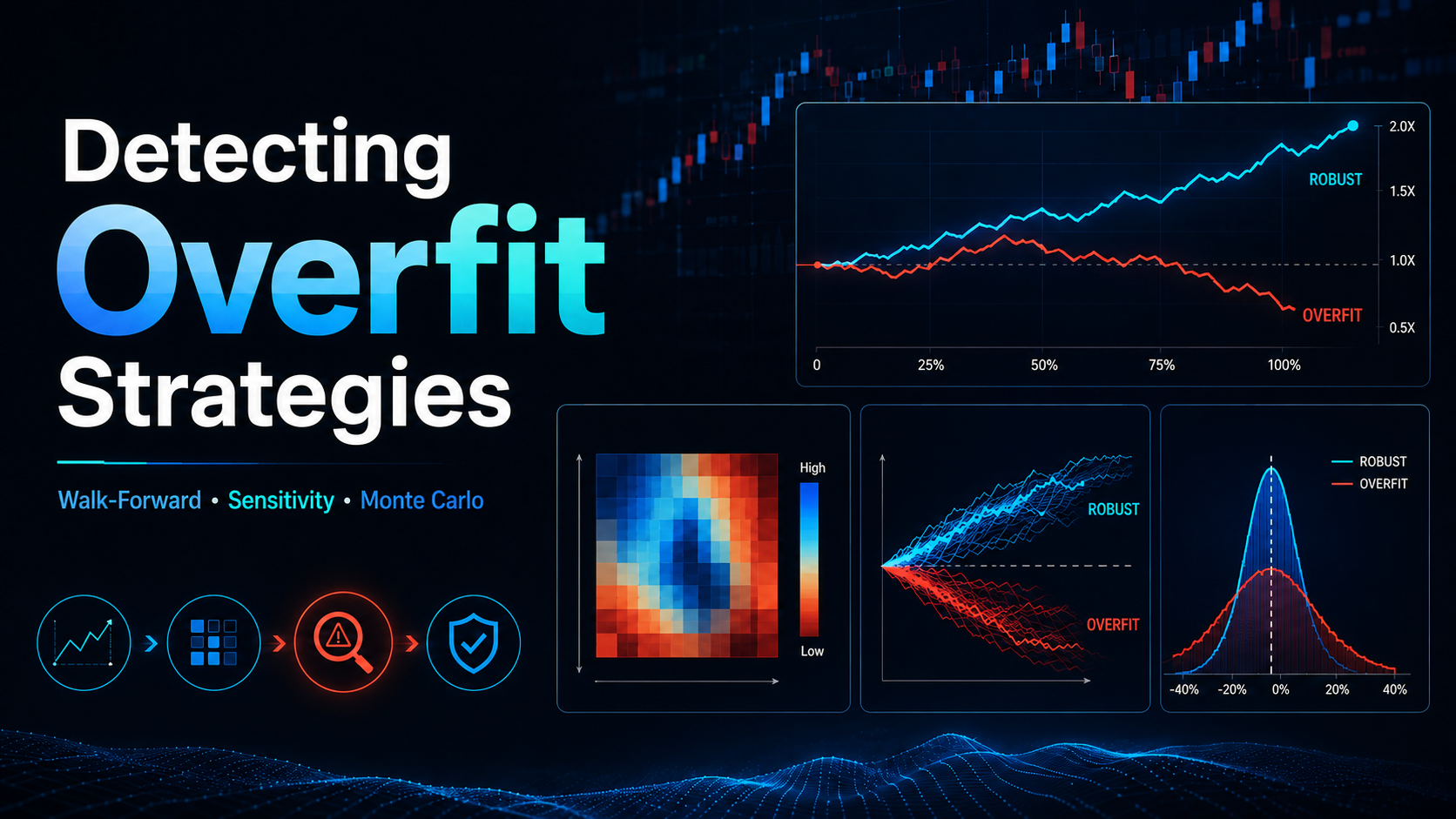
Overfitting is the silent killer of algorithmic strategies. Learn how to stress-test your trading system with Walk-Forward Analysis, Parameter Sensitivity Heatmaps, and Monte Carlo Trade Sequencing to avoid costly mistakes.
### Key Takeaways
Overfitting is the silent killer of algorithmic strategies, hiding in over-optimized parameters, short testing windows, weak out-of-sample validation, and lucky trade sequences. A robust validation framework requires three sequential checks: Walk-Forward Analysis, Parameter Sensitivity Heatmaps, and Monte Carlo Trade Sequencing. The ultimate test of any system is the live-versus-backtest variance observed across the first 100 live executions. If the real-time equity curve deviates significantly from the backtested projection, the strategy may be overfit, execution costs may be poorly modeled, or the underlying market regime may have changed.
### The Hidden Danger in Your Backtest Results
Most algorithmic trading systems are overfit. The unfortunate reality is that many systematic traders don't realize this until the strategy is deployed live, capital is on the line, and the system begins to experience unprecedented drawdowns. You've probably seen it happen: a strategy looks perfect on paper, but as soon as real money hits the table, everything falls apart.
To prevent this, traders need a rigid, objective stress-testing workflow. Whether you're generating EAs in specialist strategy-building platforms, coding custom Pine Script logic in TradingView, using LuxAlgo Quant to generate and validate TradingView indicators or strategies, or routing webhook alerts to automated environments, your strategy must survive a gauntlet of specific robustness checks before it ever touches a live account.
Here's the definitive guide to filtering out the noise and identifying truly robust trading systems.
### What Does Overfitting Actually Look Like?
An overfit model is one that has essentially memorized historical data but fails completely when presented with new, unseen market conditions. On paper, it looks flawless: an impossibly smooth equity curve, a Sharpe ratio well above 3.0, and maximum drawdowns that barely register.
Consider this scenario: A trader builds a mean-reversion strategy on GBP/JPY keyed to a 43-period moving average. Across a four-year backtest, the metrics are spectacular. However, if that lookback period is adjusted to 42 or 44 periods, the total return plummets by 40%. The strategy hasn't discovered a true market edge; it has simply curve-fit a historical accident. The lookback was hyper-tuned to perfectly map past price action that will never replicate in the exact same way again.
Overfitting doesn't announce itself. It hides behind impressive surface-level metrics and only reveals itself months into live trading when a regime shift occurs. That's why strategy development shouldn't end once a script compiles or a backtest looks profitable. For traders building on TradingView, an AI coding agent such as LuxAlgo Quant can help speed up Pine Script generation, validation, and debugging, but the final strategy still needs independent robustness testing before it's trusted with real capital.
### Why Standard Robustness Checks Often Fail
Most backtesting engines and algorithmic building platforms offer validation tools like parameter sweeps, out-of-sample testing, and Monte Carlo simulations. The problem isn't the tools; it's how traders use them. Bias often creeps into the testing phase, leading to three common failure modes:
- **Short Walk-Forward Windows:** Optimizing a strategy over three months and testing it out-of-sample for one month proves almost nothing because the underlying market regime may not have changed enough to challenge the model.
- **Cherry-Picked Parameter Sweeps:** Traders often run massive parameter optimization sweeps and simply select the combination that yields the highest net profit. This is optimization working against you because it rewards historical coincidence instead of durable behavior.
- **Randomizing the Wrong Data:** Many traders run Monte Carlo simulations that randomize price paths by adding noise to the candlesticks. While interesting, this is often less practical than randomizing the sequence of your historical trades, because trade-order risk is what directly affects drawdown, risk of ruin, and position sizing.
### Building a Robust Validation Framework
To combat these pitfalls, every candidate strategy needs to pass through a three-stage validation process. Think of it as a stress test for your trading system, designed to expose weaknesses before they cost you real money.
**Stage 1: Walk-Forward Analysis**
This technique involves repeatedly optimizing your strategy on a rolling window of historical data and testing it on the next unseen period. If your strategy can't consistently perform across multiple walk-forward cycles, it's likely overfit. Aim for at least 20 walk-forward cycles covering different market regimes.
**Stage 2: Parameter Sensitivity Heatmaps**
Instead of just looking at the best parameter set, visualize how performance changes across a range of parameters. A robust strategy will show a plateau of good performance, not a sharp peak. If small changes in parameters cause huge swings in returns, you're looking at an overfit model.
**Stage 3: Monte Carlo Trade Sequencing**
Randomize the order of your historical trades to see how different sequences affect your equity curve. This helps you understand the impact of trade-order risk on drawdown and risk of ruin. A robust strategy should survive most random sequences without catastrophic losses.
### The Ultimate Test: Live vs. Backtest Variance
The ultimate test of any system is the live-versus-backtest variance observed across the first 100 live executions. If the real-time equity curve deviates significantly from the backtested projection, the strategy may be overfit, execution costs may be poorly modeled, or the underlying market regime may have changed.
Track this variance carefully. A healthy strategy will show some deviation, but it should be within expected bounds. If you're seeing drawdowns that are double what your backtest showed, it's time to go back to the drawing board.
Remember, the goal isn't to find the perfect strategy. It's to find a strategy that's robust enough to handle the messy, unpredictable reality of live markets. Take the time to stress-test your systems properly, and you'll save yourself from painful losses down the road.