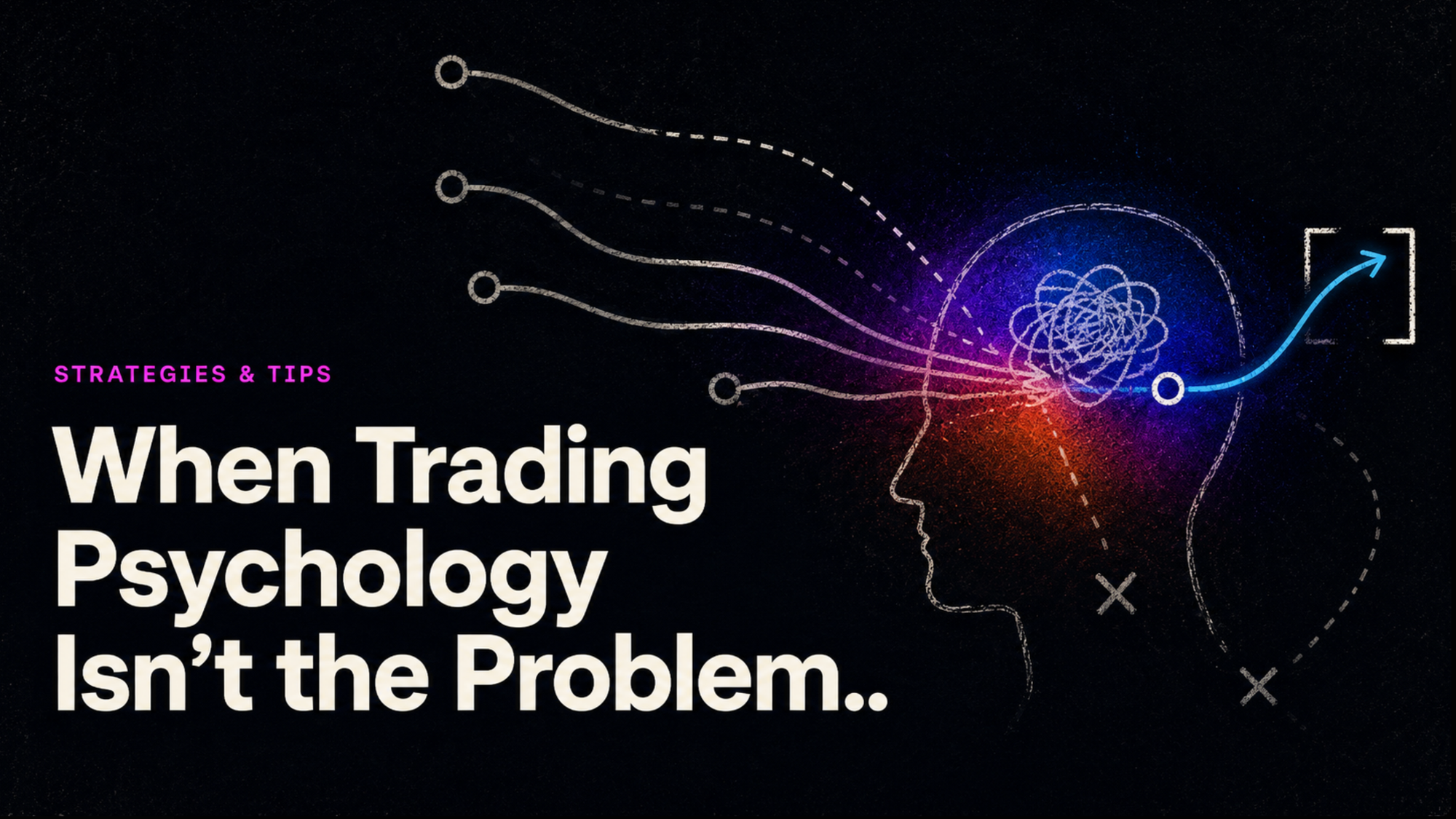
If you follow your rules and still lose money, your mindset may not be the issue. The problem might be your strategy's edge, costs, risk, execution, or market fit. Here's how to diagnose it.
If you follow your rules and still lose money, your mindset may not be the main issue. In many cases, the problem is simpler: the strategy has no edge, costs are too high, risk is off, execution differs from the test, or the market has changed.
Here's the short version:
- Backtests often look better than live results because historical tests cannot perfectly reproduce unseen data, liquidity, trading costs, or real execution.
- A bad result can come from system flaws, not just fear or greed.
The main checks are:
- Out-of-sample and walk-forward testing
- Live fills vs. backtest fills
- Slippage, spreads, commissions, and financing costs
- Position sizing and stop placement
- Market regime fit
- Sample size, overfitting, and data quality
A weak system can look like a discipline problem. A working system can look broken if your expectations are off.
I'd look at it in this order:
1. Did I follow my rules?
2. Does the strategy still show an edge on unseen data?
3. Are trading costs killing the setup?
4. Is my risk per trade too high?
5. Does this market still fit the strategy?
6. Am I judging the system by facts or by frustration?
A few numbers can help keep the review grounded, but they should be treated as screening thresholds rather than universal pass-or-fail rules. Some traders look for a profit factor above 1.5 and a maximum drawdown below 20%, but the appropriate targets depend on the instrument, strategy frequency, leverage, and risk tolerance. A 2:1 reward-to-risk ratio is not automatically better if the win rate is too low. If a key live metric deteriorates by 20% to 30% relative to the tested range, I'd investigate it, but I would also check whether that difference is statistically meaningful for the number of trades observed.
### Quick Comparison
| Problem type | What it looks like | What I'd check first |
|---|---|---|
| Behavior problem | Moving stops, skipping trades, revenge trading | Journal, rule-following, process drift |
| System problem | Following rules but still losing | Edge, data, costs, regime fit |
| Risk problem | One loss wipes out many wins | Position size, stop distance, drawdown |
| Execution problem | Backtest looks fine, live trading does not | Slippage, spread, fill quality, latency |
| Expectation problem | Normal drawdown feels like failure | Baseline returns, drawdown history, sample size |
The core point is simple: don't treat every losing stretch like a psychology issue. Mindset matters when it changes how you execute, but it should not become a catch-all explanation. I'd fix only what the data shows: behavior, system design, risk, execution, or market fit.
### A Weak Strategy Can Look Like a Psychology Problem
If you're following your rules and still getting poor results, step back and test the strategy itself. A trader can do everything "right" and still lose money. When that happens, the issue may not be mindset at all. It may be the system.
Think of it this way: if you're driving a car with a flat tire, no amount of positive thinking will get you to your destination faster. You need to check the tire. The same logic applies to trading. Your discipline might be flawless, but if the underlying system is broken, you'll keep spinning your wheels.
### No Edge, Overfitting, and Small Sample Size
One common problem is a strategy with no durable edge. On a chart, it can look neat and convincing. But a strong historical result alone does not prove much. A system can look good on paper and still fall apart when it reaches unseen data or live execution.
Three flaws tend to cause this:
- **Overfitting** means the strategy is matching historical noise instead of a repeatable relationship. There is no universal rule that limiting a strategy to two or three parameters makes it safe. Every additional parameter, filter, market, timeframe, and tested variation increases the opportunity to select a lucky result. Research on the probability of backtest overfitting shows why the number of trials matters, not just the complexity of the final strategy.
- **Look-ahead and survivorship bias** occur when the test uses information or instruments that would not have been available at the time. The CFA Institute's 2026 backtesting guidance highlights long-standing concerns about these biases, but many traders still fall into the trap.
- **Small sample size** makes it nearly impossible to distinguish a real edge from random luck. If you're judging a strategy on 30 trades, you're basically flipping a coin and calling it science. You need hundreds, ideally thousands, of trades to build confidence.
### How to Diagnose Your Own System
Start by asking yourself the six questions I listed earlier. Write down the answers. Don't rely on memory because frustration clouds judgment. Then, pull up your trade log and compare your live fills against what your backtest predicted. Look at slippage, spreads, and commissions. If those numbers are significantly worse than expected, your execution might be the culprit, not your psychology.
Finally, check whether the market regime has shifted. A trend-following strategy that worked beautifully in a trending market will look terrible in a choppy one. That's not a flaw in you or the strategy; it's just a mismatch between your approach and the current environment.
### The Bottom Line
Don't blame yourself for system problems. Run the diagnostics, look at the data, and fix what's actually broken. Your mindset matters, but it's not the only thing that matters. Sometimes the smartest move is to step back, audit your process, and let the numbers tell you where the real problem lives.